The Gymscore training library · Comparisons
How to Choose Lift Variations: A Guide to Five Useful Comparisons
Use observed form scores to ask better questions about exercise choice, then choose a variation that fits your goal and track it on its own terms.
Observed average form scores by exact exercise label
Compare the options below. Scroll the table sideways on smaller screens.
| Comparison | Variation average /100 | Reference average /100 | Observed gap |
|---|---|---|---|
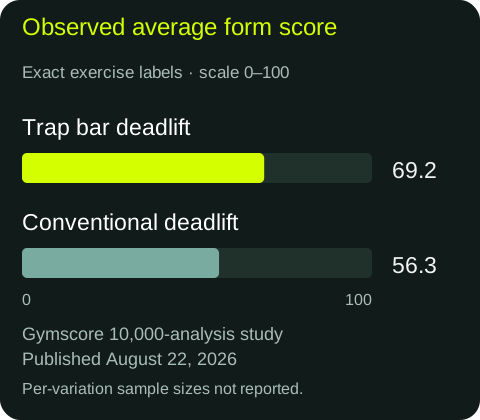
| Trap bar vs conventional deadlift | 69.2 | 56.3 | +12.9 points |
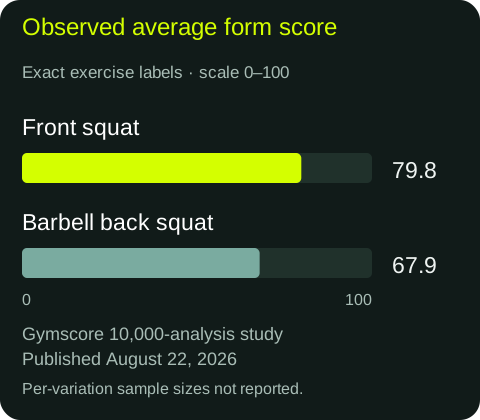
| Front vs barbell back squat | 79.8 | 67.9 | +11.9 points |
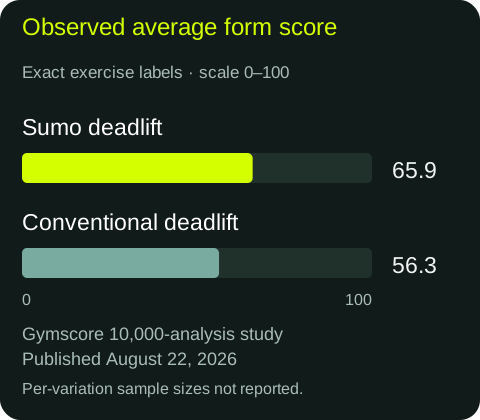
| Sumo vs conventional deadlift | 65.9 | 56.3 | +9.6 points |
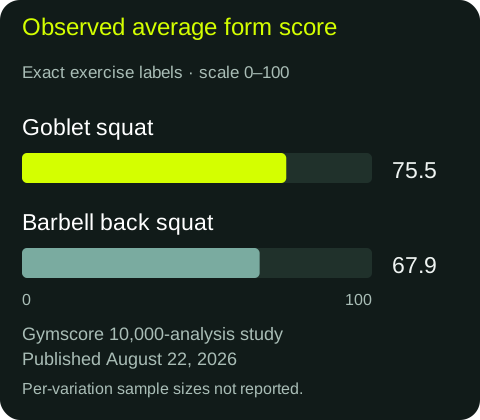
| Goblet vs barbell back squat | 75.5 | 67.9 | +7.6 points |
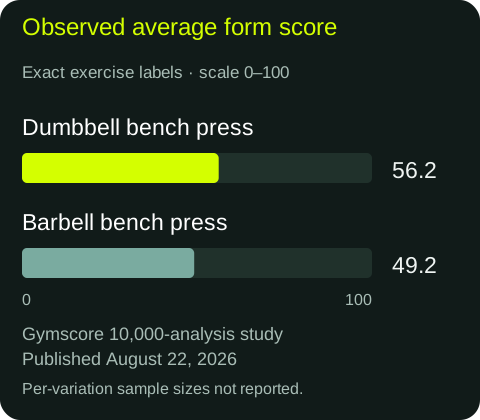
| Dumbbell vs barbell bench press | 56.2 | 49.2 | +7.0 points |
Source: Gymscore’s current 10,000-analysis study, published August 22, 2026. These are different self-selected exercise groups, not matched trials. Per-variation sample sizes are not reported in the published comparison; 10,000 is the whole dataset, not each pair’s denominator. The source does not establish a collection window. Sources and context ↓
Quick picks
- Learning a hinge with suitable equipment → compare a light trap bar pull with conventional technique.
- Want a different squat loading position → try front or goblet squats with a manageable load.
- Considering sumo → evaluate stance, comfort and your program’s purpose rather than chasing its cohort average.
- Want more freedom to choose your pressing grip → compare dumbbells with your usual barbell setup.
- Training for a specific tested lift → keep that lift in the plan and use variations deliberately.
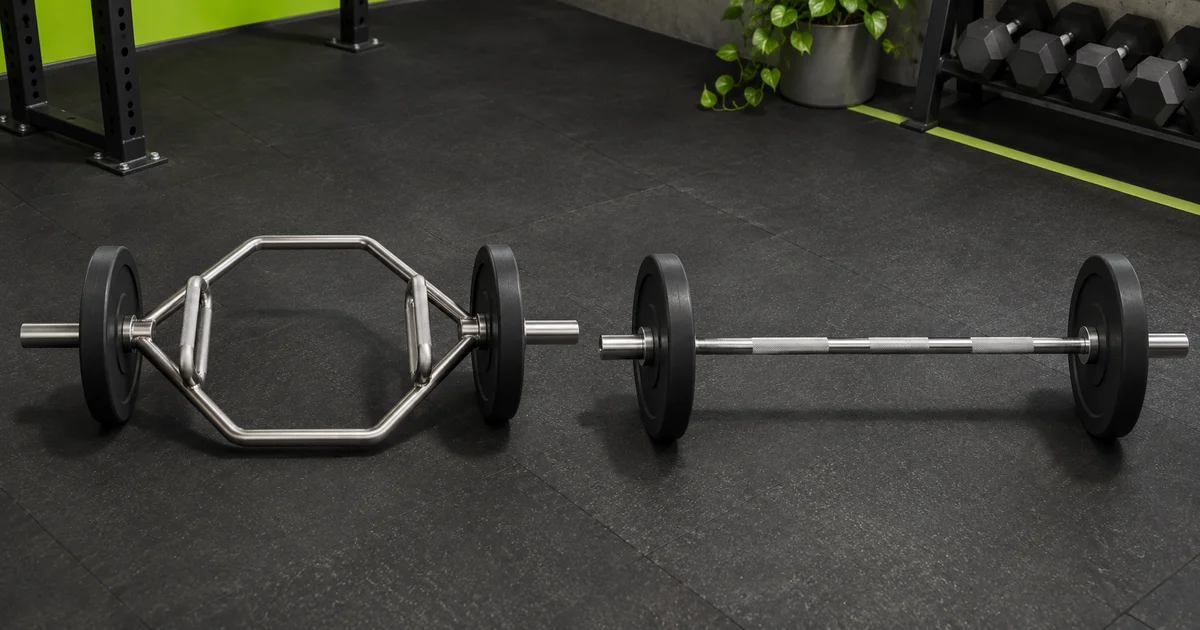
Five comparisons and what to do with them
Observed gap: +12.9 points
Trap bar versus conventional deadlift
In the published 10,000-analysis study, trap bar deadlifts averaged 69.2 and conventional deadlifts 56.3. The trap bar places the lifter inside the load and can offer different handle heights. It changes the task; it does not prove that switching bars improves everyone’s form by 12.9 points.
- When to use this
- Consider it when the available handles and loading position help you practice a controllable pull, or when your program allows a general strength variation.
- Your next step
- Identify the handle height and keep it consistent. Choose a load for the variation you are testing instead of copying your conventional working weight.
- Put it into practice
- Film a manageable set from a clear side angle. Compare setup, the start of the pull and how consistently the reps finish, without using raw load as a verdict.
- Common mistake
- Treating high-handle and low-handle pulls as the same task, or abandoning conventional practice when it is the lift you need to perform.
- What to log next
- Log the bar type, handle height, load and reps. Keep separate records for each variation.
Observed gap: +11.9 points
Front squat versus barbell back squat
Front squats averaged 79.8 versus 67.9 for barbell back squats in the published comparison. The front-rack position changes how you balance the load and demands a setup you can maintain. The lifters choosing front squats may also differ in experience from those choosing back squats.
- When to use this
- Consider a front squat when its loading position fits your training goal and you can establish a comfortable, stable front rack.
- Your next step
- Learn the rack position with light practice before judging the variation under working load. Choose a grip or strap-assisted rack that you can control with appropriate guidance.
- Put it into practice
- Use a consistent depth target and film the full movement. Watch whether the elbows and torso position remain repeatable across repetitions.
- Common mistake
- Reading the average as proof that front squats are easier for every beginner, or forcing a rack position that causes pain.
- What to log next
- Log the exact variation and rack setup. A front-squat PR and a back-squat PR are different records.
Observed gap: +9.6 points
Sumo versus conventional deadlift
Sumo deadlifts averaged 65.9 versus 56.3 for conventional deadlifts in the study. A wider stance and hands inside the legs change the setup. Neither variation is universally correct for a particular body type based on this dataset; the comparison did not randomly assign people to stances.
- When to use this
- Consider sumo when it fits your goal, equipment and a stance you can control, especially if you want to compare how two setups feel during light practice.
- Your next step
- Find a manageable stance rather than pushing your feet as wide as possible. Keep the bar close and establish tension before moving it.
- Put it into practice
- Give the unfamiliar variation enough practice that the first awkward attempt is not your only comparison. Use suitable loads for each stance.
- Common mistake
- Choosing a stance solely because its published average is higher, or assuming that one video reveals your ideal long-term variation.
- What to log next
- Record stance and load separately. Compare consistency, effort and your training goal alongside the footage.
Observed gap: +7.6 points
Goblet squat versus barbell back squat
Goblet squats averaged 75.5 versus 67.9 for barbell back squats. Holding a dumbbell or kettlebell in front creates a different balancing task and a straightforward way to practice squatting. Eventually, holding the implement may limit the load before your legs do.
- When to use this
- Consider it for practicing a squat pattern, working with limited equipment or choosing a variation that fits the session’s purpose.
- Your next step
- Use an implement you can hold securely without turning the setup into the hardest part of the exercise. Keep the movement range consistent.
- Put it into practice
- Film a controlled set and observe foot contact, balance and repetition consistency. Use the result to choose a cue rather than chase the group-average score.
- Common mistake
- Assuming a higher average means the goblet squat is superior for every goal, including heavy barbell-specific strength.
- What to log next
- Log the implement and load, plus whether grip or the squat itself limited the set.
Observed gap: +7.0 points
Dumbbell versus barbell bench press
Dumbbell bench presses averaged 56.2 versus 49.2 for barbell bench presses in the exact-label comparison. Independent implements allow a different grip and arm path, but also require their own setup and control. The average difference does not identify which variation will suit your shoulders.
- When to use this
- Consider dumbbells when their grip options, available load increments and setup suit your plan, or when you want a distinct pressing variation.
- Your next step
- Use a load you can get into position and finish safely. Keep your feet and upper back stable and choose a controllable range.
- Put it into practice
- Compare consistency across a manageable set rather than adding the two dumbbell weights and treating the result as an equivalent barbell lift.
- Common mistake
- Using a score difference as medical advice, or selecting dumbbells too heavy to set up and put down under control.
- What to log next
- Record weight per hand, bench angle, repetitions and grip choice. Keep barbell and dumbbell PRs separate.
Compare two variations without confusing the result
- Define the reason for the comparison
Choose the training question: equipment fit, practice consistency, a program requirement or a different loading position. A higher cohort score is not a goal by itself.
- Practice both setups
Use manageable loads and learn any unfamiliar equipment before comparing demanding sets. Keep the testing conditions as consistent as practical.
- Log each variation separately
Record exact exercise, equipment, load, repetitions and effort. Save a clear video that includes the setup and the complete set.
- Choose by fit and repeatability
Review control, comfort, progression options and the purpose of your program. Keep the variation that fits that purpose, and reassess after practicing it.
What these score differences can and cannot tell you
The figures are averages among submitted analyses, not a randomized trial or a matched comparison of the same lifters. Different experience levels, equipment and exercise choices can contribute to the differences. Repeated sets are also not independent participants.
The source uses exact exercise labels for this comparison, while its headline deadlift, squat and bench sections group exercise families. That explains why a barbell back squat average here differs from the overall squat-family average. Do not mix those baselines when quoting a difference.
Build progression around the variation you actually train. Use a repeatable technique standard, an appropriate progression rule and separate log entries. Keep v1 and v2 form scores separate; a model change is not evidence that your lifting suddenly improved or deteriorated.
Questions answered
Does a higher average score mean an exercise is easier?
No. Scores reflect the submitted exercise groups, which may differ in experience and other ways. The published study does not establish a universal difficulty ranking.
Will switching to a trap bar add 12.9 points to my score?
No. That is the observed difference between group averages in the published comparison, not an expected effect for an individual lifter. Practice and assess the variation on its own terms.
How many analyses are in each comparison?
The overall source contains 10,000 analyses. The published comparison does not report the sample size for each exact exercise variation, so it would be misleading to claim 10,000 observations for each pair.
Why do these averages differ from the main squat and deadlift findings?
The comparison uses exact exercise labels, whereas the headline findings group exercise families. Keep each average paired with its own population and label.
Should I replace my main lift with the highest-scoring variation?
Choose based on the purpose of your program, equipment and what you can practice consistently. If you train for a specific lift, a variation can support that work without replacing the lift you need to perform.
Sources and context
Published by the team behind Gymscore. Our editorial methodology explains how we use sources and update our guides.