Trap Bar vs Conventional Deadlift: Which Is Better for You?
Read this article in Deutsch, Español, Français, Italiano, Nederlands, Polski, Português, Svenska.
Trap bar deadlifts scored 12.9 points higher than conventional in Gymscore's form data. When to pick each, how the setup differs, and how to switch.
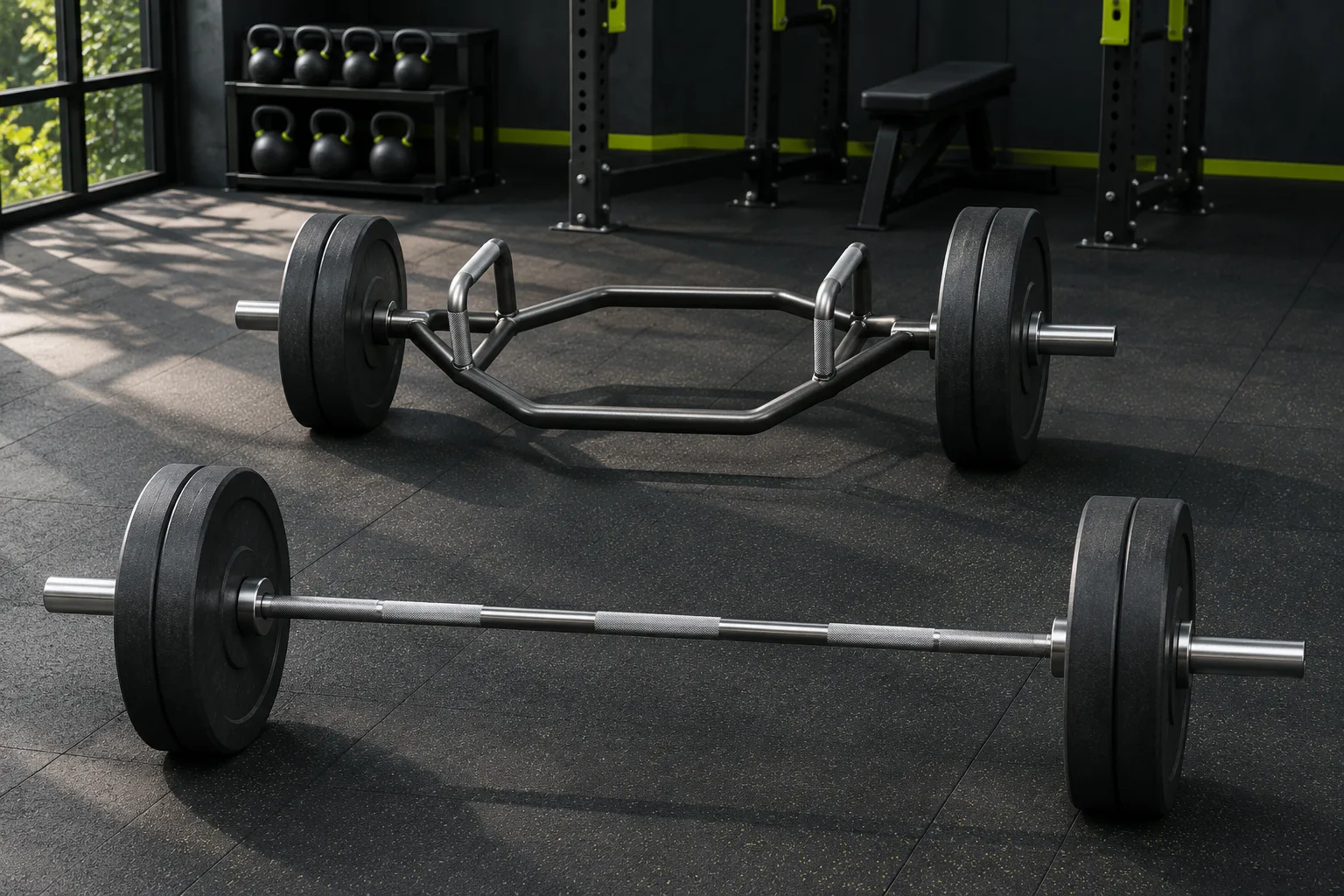
Published by the team that makes Gymscore. These observational app scores describe submitted videos, not injury risk or clinical outcomes. Repeat sets are not independent participants; exercise groups differ, and score changes do not prove cause or guarantee progress. See the original analysis and our editorial methodology. Cover image is AI-generated for illustration.
TL;DR
- For most people training for general strength and muscle, the trap bar deadlift is the easier, more forgiving default. The conventional deadlift is the one to train if you compete in powerlifting or specifically want a straight-bar hinge.
- In Gymscore's analysis of nearly 10,000 filmed lifts, trap bar deadlifts averaged 69.2 out of 100 against 56.3 for conventional deadlifts, a 12.9-point gap.
- Trap bar scores also improved faster with repeat filming: +2.52 points per attempt vs +1.55 for conventional.
- The same pattern shows up across the dataset: front squats, sumo deadlifts, goblet squats and dumbbell bench all scored higher than their "standard" versions.
- Neither lift is bad. Pick by goal, and film whichever one you do.
Trap bar vs conventional deadlift: the quick answer
| Trap bar (hex bar) deadlift | Conventional deadlift | |
|---|---|---|
| Where the load sits | At your sides, in line with your body | In front of your shins |
| Torso | More upright | More bent over |
| Grip | Neutral handles | Overhand, mixed or hook grip |
| Learning curve | Easier for most people | More technical |
| Average Gymscore form score | 69.2 | 56.3 |
| Score change per repeat attempt | +2.52 | +1.55 |
| Best for | General strength, athletes, beginners, high-volume pulling | Powerlifting, straight-bar strength, hinge practice |
What the data says
The analysis compared technique categories including postural alignment, foot placement, range of motion and overall movement quality. The current app also gives feedback on bracing.
Conventional deadlifts were one of the harder lifts to do well. Across 1,339 deadlift analyses, posture was the weakest sub-score in 67.1% of lifts, averaging 42.1, the lowest sub-score for any lift. Hips shooting up appeared in 20.4% of deadlifts and lower back rounding in 15.1%.
Standing inside a trap bar can allow a more upright torso and changes the mechanics of the pull. The observed scores were 69.2 versus 56.3, but differences between the people using each bar may also contribute.
Easier variations score higher across the board
This isn't just a deadlift thing. Every time we compared a more supported or easier-to-balance variation with its standard version, the variation scored higher:
| Variation | Avg score | Compared with | Avg score | Gap |
|---|---|---|---|---|
| Trap bar deadlift | 69.2 | Conventional deadlift | 56.3 | +12.9 |
| Front squat | 79.8 | Barbell back squat | 67.9 | +11.9 |
| Sumo deadlift | 65.9 | Conventional deadlift | 56.3 | +9.6 |
| Goblet squat | 75.5 | Barbell back squat | 67.9 | +7.6 |
| Dumbbell bench press | 56.2 | Barbell bench press | 49.2 | +7.0 |
Some of that is who chooses each lift. People who film a front squat have often practised it for a while. But the direction is consistent: when the load sits closer to your body, or the setup is easier to repeat, people move better.
Trap bar scores improve faster
Within users who filmed the same lift more than once, trap bar deadlift scores rose by an average of 2.52 points per repeat attempt. Conventional deadlifts rose 1.55 points per attempt (303 analyses from 56 users). These are observed changes in different cohorts, not evidence that switching bars or receiving feedback causes faster progress.
Is the trap bar deadlift easier?
For most people, yes. Stronger by Science's Greg Nuckols makes the case in Trap Bar Deadlifts are Underrated that the trap bar allows more flexibility in the movement, higher velocity and power output, doesn't need a mixed grip, and may be easier for many people to learn. This coaching argument is not evidence of a lower injury rate.
"Easier" doesn't mean "not a real deadlift." The trap bar is still a hinge, still loads your hips and back, and still lets you lift heavy. It just removes the bar in front of your shins that you have to keep close and balance over midfoot.
When to choose the trap bar deadlift
- You're new to deadlifting and want to learn to pull heavy without fighting bar position.
- You train for general strength, muscle or sport, not a powerlifting meet.
- Your conventional deadlift keeps breaking down with hips shooting up or a rounding back.
- You want more pulling volume without every set feeling like a technique test.
- Your gym has one, which not every gym does.
When to choose the conventional deadlift
- You compete in powerlifting. The IPF Technical Rulebook (effective 1 March 2026) requires that "the bar shall be straight," so a trap bar isn't an option on the platform. Other federations set their own rules; check yours.
- You want to practise a straight-bar hinge, with the bar in front of you.
- You want more hamstring and lower back emphasis in your pulling.
- You like it. The lift you'll actually do consistently beats the lift that's theoretically better.
You don't have to pick only one. Plenty of lifters pull conventional on one day and trap bar on another, or use the trap bar while they rebuild their conventional technique.
What about sumo?
Sumo deadlifts averaged 65.9 in our data, 9.6 points above conventional. A wider stance with your hands inside your knees lets you start more upright, a bit like the trap bar. The IPF deadlift rules set no stance requirement, so sumo is legal on the platform and an option if you compete and your conventional pull keeps breaking down.
Trap bar deadlift setup checklist
- Stand in the middle of the bar, handles in line with the middle of your feet.
- Feet about hip width.
- Hinge and bend your knees until you can grip the handles in the middle.
- Chest up, shoulders down, arms straight.
- Pull the slack out until the plates click.
- Breathe and brace.
- Push the floor away; hips and chest rise together.
- Stand tall at the top without leaning back.
- Lower under control, staying centred in the bar.
Common trap bar deadlift mistakes
- Standing off-centre, so the bar tips forward or back.
- Turning it into a squat: hips too low, chest too upright, all knees.
- Turning it into a stiff-legged deadlift: knees locked, hips too high.
- Leaning back at lockout.
- Dropping the weight instead of lowering it.
Common conventional deadlift mistakes
- Hips shooting up before the bar moves (20.4% of deadlifts in our data). See hips shooting up in the deadlift.
- Lower back rounding (15.1%, with scores 17.0 points lower).
- Bar drifting away from your legs.
- Jerking the bar instead of pulling the slack out.
- Worrying about the feet. Foot placement was the weakest part of only 4.7% of deadlifts.
How to switch between them
Going from conventional to trap bar
Start lighter than you think. Many people can lift more with a trap bar, but find a weight where you can keep your hips and chest rising together, then build from there. Film your first sessions.
Going from trap bar to conventional
Use the conventional deadlift as a technique lift at first: lighter weights, paused reps just below the knee, and close attention to keeping the bar over midfoot. Progress the conventional load when you can repeat the setup and maintain control. An app score alone should not determine loading.
How to film your deadlift (either version)
- Side-on at hip height, whole body and plates in frame. This shows hip height, back position and whether hips and chest rise together.
- Film from setup, including the slack pull.
- For the trap bar, also film once from the front to check you're centred in the bar.
- Compare first and last reps to see if fatigue changes your position.
To get a score, film your deadlift in Gymscore. You get a 0-100 form score with sub-scores for postural alignment, bracing, foot placement, range of motion and overall movement quality, plus tips on what to fix. The deadlift form checker page shows what to keep in frame. For more lifts, see our analysis of nearly 10,000 filmed lifts, and for how quickly scores move, how long it takes to fix your form.
Try both bars this week, film one set of each side-on, and compare the scores in Gymscore.
FAQ
Is the trap bar deadlift better than the conventional deadlift?
For most people training for general strength and muscle, the trap bar is the easier and more forgiving option. The conventional deadlift is better if you compete in powerlifting or want straight-bar hinge practice. In Gymscore's data, trap bar deadlifts averaged 69.2 vs 56.3 for conventional deadlifts.
Is the trap bar deadlift easier?
For most lifters, yes. The load sits at your sides instead of in front of your shins, so it's easier to stay upright and keep your back in position. Trap bar deadlift scores in Gymscore also improved faster with repeat filming: 2.52 points per attempt vs 1.55 for conventional.
Is the trap bar deadlift a real deadlift?
Yes. It's still a hinge that trains your hips, legs and back, and you can lift heavy with it. It's just not allowed in IPF powerlifting, where the bar must be straight.
Is the trap bar deadlift easier on the lower back?
Many lifters find it is, because the more upright position puts less demand on the lower back. If you have back pain, see a qualified professional such as a doctor or physiotherapist before choosing a variation.
Should beginners do trap bar or conventional deadlifts?
The trap bar is the easier place to start for most beginners. It's simpler to set up, and in Gymscore's data it scored 12.9 points higher on average. You can add conventional deadlifts later if you want to compete or train a straight-bar pull.
Why do easier lift variations score higher?
When the load sits closer to your body, or the setup is easier to repeat, most people hold better positions. In Gymscore's data, trap bar, front squat, sumo, goblet squat and dumbbell bench all scored between 7.0 and 12.9 points above their standard versions.