The Gymscore training library · Plans
Workout Plan Types: How to Choose a Routine You Can Follow
Choose a weekly structure you can repeat, then pair it with clear exercises, progression rules and a workout log.
Workout plan comparison: example schedules, fit and trade-offs
Compare the options below. Scroll the table sideways on smaller screens.
| Type | Example days/week | Useful starting point | Main trade-off |
|---|---|---|---|
| Full body | 2–3 | New lifter or limited gym days | Manage how much fits into one session |
| Upper/lower | 4 | Lifter who wants focused sessions | Needs a reliable four-day schedule |
| Push/pull/legs | 3 or 6 | Lifter who enjoys movement-group sessions | Three days usually means one pass per group |
| 5/3/1 | 3–4, by template | Lifter wanting explicit strength progression | Must follow a particular template, not just its name |
| nSuns LP | 4–6, by version | Lifter with experience and time for substantial work | Long sessions and recovery demands |
| AI custom | Your actual availability | Unusual equipment, schedule or preferences | Generated details still need review |
Schedules are illustrative planning examples, not measured Gymscore outcomes. A split organizes the week; a complete program also specifies exercises, effort, progression and adjustments. Sources and context ↓
Quick picks
- Only two or three reliable gym days → start by comparing full-body plans.
- Four reliable days and a preference for focused sessions → consider upper/lower.
- Want clear barbell progression rules → compare a specific 5/3/1 template with nSuns, including session workload.
- Limited equipment or a changing schedule → describe those constraints in a custom plan, then check every exercise.
Six ways to organize your training
Best for: a compact weekly schedule
Full body
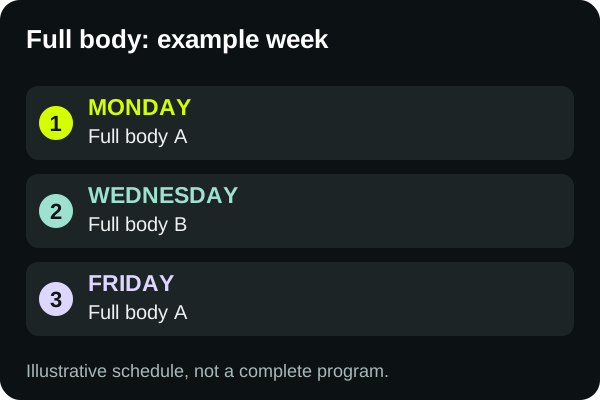
A full-body session includes movements for the upper and lower body. The exercise selection can change between sessions while the main patterns repeat. It is a straightforward way to practice several lifts without dedicating an entire day to one body part.
- When to use this
- Choose it when you can consistently train a few days and want a manageable routine before adding complexity.
- Your next step
- Start with a squat or leg-press pattern, a hinge, a push and a pull across the week. Select variations you can set up confidently.
- Put it into practice
- Try alternating two clearly written sessions. Rehearse the exercise order with comfortable loads before trying to progress.
- Common mistake
- Do not turn every session into a test of every lift. Too many demanding exercises can make the final movements rushed.
- What to log next
- Record completed sessions, working sets, reps and effort. Keep the exercise list stable enough to compare successive sessions.
Best for: four predictable training days
Upper/lower
An upper/lower split separates upper-body and lower-body sessions. It can leave more room for a lift and its supporting exercises than a crowded full-body session. The split alone says nothing about how hard each set should be.
- When to use this
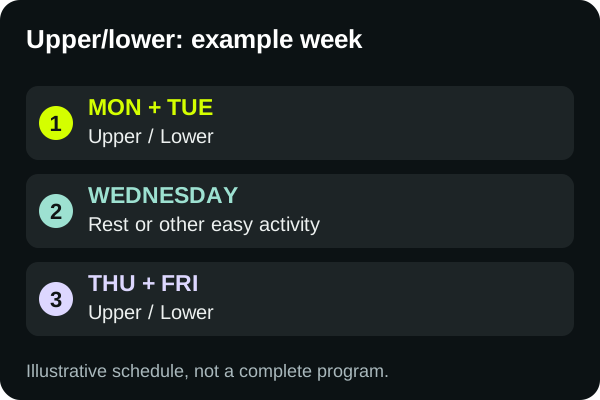
- Choose it when four sessions fit your normal week, rather than only your most motivated week.
- Your next step
- Write upper and lower sessions with a clear main movement, supporting movements and a realistic end time. Leave room for rest between demanding sessions.
- Put it into practice
- Use an upper, lower, rest, upper, lower example week. Swap calendar days when needed while keeping the session sequence clear.
- Common mistake
- Avoid treating both lower sessions as maximum-effort days simply because they are separated on the calendar.
- What to log next
- Log performance and session length. If missed sessions repeatedly remove one half of the plan, simplify the schedule.
Best for: focused movement-group sessions
Push/pull/legs
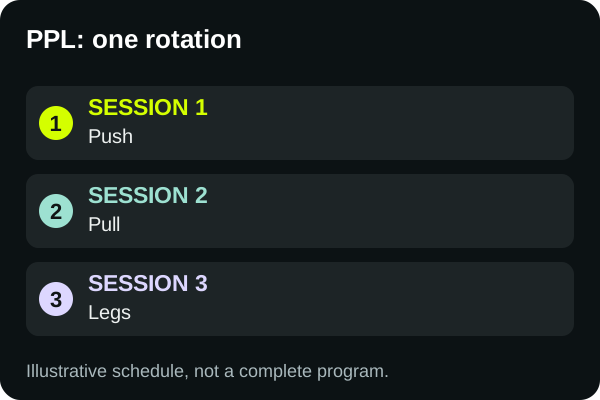
PPL groups pushing movements, pulling movements and leg training. One rotation can occupy three sessions; repeating it can occupy six. Those schedules have different demands, so the label is not a complete prescription.
- When to use this
- Choose it when you enjoy this structure and can complete the full rotation consistently.
- Your next step
- Count each muscle group’s weekly work before adding exercises. A six-day calendar does not require six exhausting sessions.
- Put it into practice
- Draft one push, pull and leg session first. Check that each is short enough to finish with the planned rest periods.
- Common mistake
- Do not choose six days only because it sounds advanced. Missing the same day each week can leave a recurring gap.
- What to log next
- Track the entire rotation, not just Monday through Sunday. Compare whether all three session types are actually being completed.
Best for: a defined strength progression system
5/3/1
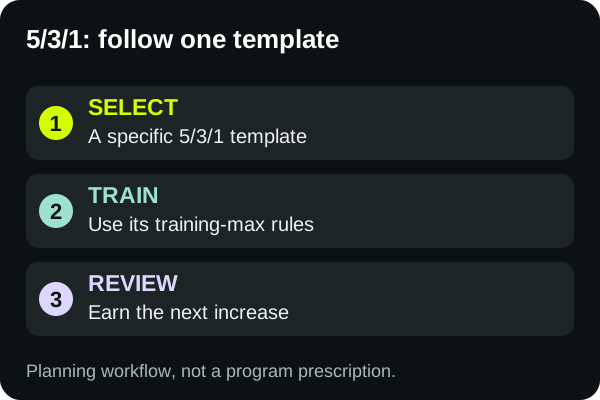
Jim Wendler’s 5/3/1 is a program family, not a body-part split. Its templates organize main lifts, training-max-based loading and supporting work. Wendler also publishes a three-day beginner template; not every 5/3/1 variation has the same schedule.
- When to use this
- Choose a specific template when you want explicit loading rules and are willing to follow its complete instructions.
- Your next step
- Read that template’s rules for the training max, assistance work and progression. Start conservatively rather than entering an aspirational maximum.
- Put it into practice
- Run the prescribed opening sessions and review rep quality before increasing the training max. Follow the selected template’s conditions.
- Common mistake
- Do not combine one version’s main work, another version’s assistance and a third version’s progression while calling it the original program.
- What to log next
- Keep the template name, training max, working loads and completed reps in the log so changes remain interpretable.
Best for: lifters who can support substantial session work
nSuns linear progression
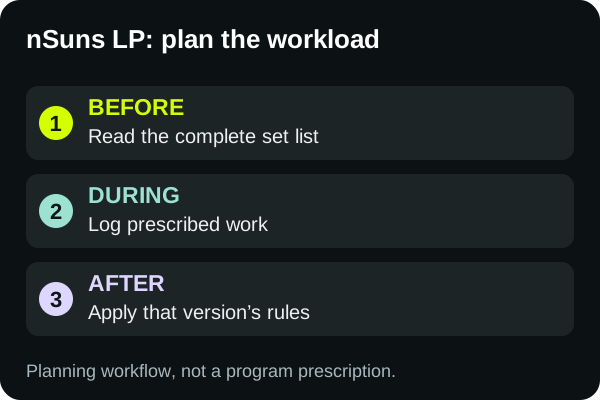
nSuns LP is another named program family rather than a split. Its spreadsheet versions include four-, five- and six-day options, with main and secondary lifts and substantial prescribed set work. The linked sheet makes progression decisions from recorded performance.
- When to use this
- Consider it after you have established exercise technique, consistent attendance and enough session time. A simpler routine remains a reasonable choice.
- Your next step
- Inspect the complete daily set list before choosing a version. Use the sheet’s own training-max and progression instructions.
- Put it into practice
- Walk through one example week on paper, including rest and assistance time, before committing your calendar to it.
- Common mistake
- Do not copy the name while discarding the workload or progression rules. Do not assume more days automatically produces better results.
- What to log next
- Log every prescribed set and the relevant top-set result, then apply the selected version’s rules. Review whether session quality is holding up.
Best for: matching your actual constraints
AI custom plan
A custom generator can organize training around goals, experience, equipment and available days. Gymscore’s web questionnaire creates a plan from those inputs. The app also supports importing photos or screenshots of an existing written routine.
- When to use this
- Choose it when a generic template repeatedly conflicts with your schedule or available equipment.
- Your next step
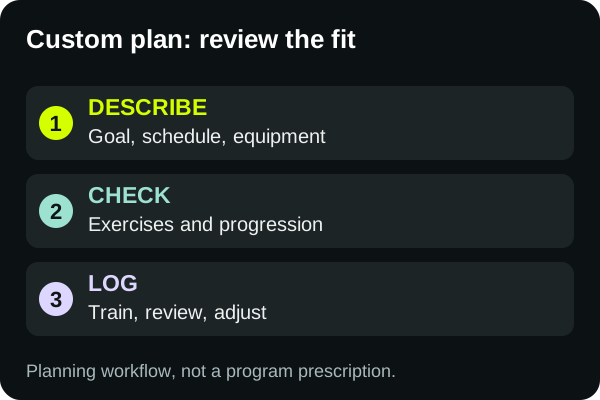
- Describe what you can actually use and how long you can train. Review exercise names, substitutions and progression instructions before starting.
- Put it into practice
- Check the first session against your gym equipment. Replace an unavailable exercise before the workout, rather than improvising midway through it.
- Common mistake
- An uploaded photo of a written program is not the same input as a photo of gym equipment. Do not assume every generation surface supports both.
- What to log next
- Keep the accepted plan and log changes. Ask for a specific adjustment when needed instead of generating a different routine after every hard session.
Choose and check a plan before your first session
- Choose a realistic attendance target
Use the days you can attend in an ordinary week, including travel, work and other sport. A plan that depends on a perfect week is difficult to evaluate.
- Pick the structure and progression rule
Select the split or named program, then identify exactly when to add reps, load or sets. A calendar without this rule is incomplete.
- Check exercise and equipment fit
Confirm that the first session can be performed with your equipment and current skill. Use appropriate alternatives before loading unfamiliar movements heavily.
- Log the first block before judging it
Record attendance, completed work and effort. Review repeated patterns rather than declaring a plan ineffective after one difficult session.
Keep the structure stable enough to learn from it
ACSM’s 2026 guidance emphasizes regular resistance training and working the major muscle groups at least twice weekly. That does not require one particular split. The examples above show ways to organize a week; the complete program determines the training dose.
A rep target and an effort target do different jobs. Reps describe the work completed; RPE describes how hard it felt. Neither automatically tells you to add weight without a progression rule. Compare the progression models hub before changing the plan.
For an initial review, ask whether you attended, completed the work with repeatable technique and recovered enough for the next session. Change the smallest useful part: an exercise, the workload, or the schedule. Keep a note of why you changed it.
Questions answered
What workout plan type is best for a beginner?
A manageable full-body routine is often a practical starting point, but there is no universal best label. Choose exercises you can perform, a schedule you can repeat and an explicit progression rule. Your equipment and available time matter more than copying a popular split.
Is push/pull/legs better than full body?
The names describe how sessions are organized, not a guaranteed difference in results. Compare total work, effort, exercise choice and the sessions you will actually complete. A three-day PPL rotation and a six-day PPL rotation also provide different schedules.
Are 5/3/1 and nSuns the same program?
No. Both have named templates with loading and progression rules, but their versions and session workloads differ. Use the exact instructions for the version you select instead of transferring rules between them.
Can I use AI to build a workout plan?
Yes, but review the result. Confirm that equipment, exercise choices, session length and progression fit your situation. In Gymscore, the web questionnaire and the app’s written-program photo import are distinct ways to create or bring in a plan.
When should I switch programs?
First check attendance, technique, effort and whether you followed the current progression rule. Consider switching when the schedule no longer fits, the equipment changes or the program consistently exceeds what you can recover from. A single missed rep is not enough information.
Sources and context
- ACSM: 2026 resistance training guidance
- Jim Wendler: the 5/3/1 philosophy for beginners
- nSuns LP spreadsheet: schedules and progression rules
- Gymscore V2 planning and import features
Published by the team behind Gymscore. Our editorial methodology explains how we use sources and update our guides.