The Gymscore training library · Tracking
What to Track in the Gym: A Complete Guide to Useful Workout Metrics
Build a workout log that explains what happened and helps you decide what to repeat, change or progress next time.
Five useful parts of a workout log
Compare the options below. Scroll the table sideways on smaller screens.
| Metric | Record | Use it to decide | Common trap |
|---|---|---|---|
| Load, reps and sets | Each working set and exercise variation | Whether the planned work was completed | Logging only the best set |
| Effort and rest | Effort estimate and rest duration | Whether two sessions are comparable | Confusing effort with a form score |
| Weekly workload | Working sets and optional volume-load | Whether workload has changed | Chasing tonnage across different exercises |
| Technique and form score | Video context, cue and relevant feedback | What to practice next | Comparing different grading versions |
| PRs and consistency | Like-for-like records and completed sessions | Whether performance and habits are progressing | Testing a maximum every workout |
Numerical examples in the illustrations are invented teaching examples, not user records or results from the Gymscore research sample. Sources and context ↓
Quick picks
- Starting a log → record exercise, load and repetitions for every working set.
- A session suddenly feels harder → compare rest and effort before changing the plan.
- More work, little progress → review working sets and recovery rather than chasing tonnage.
- Technique changes late in sets → save a representative video and one cue.
- Want a useful recap → show a genuine like-for-like PR and what you completed.
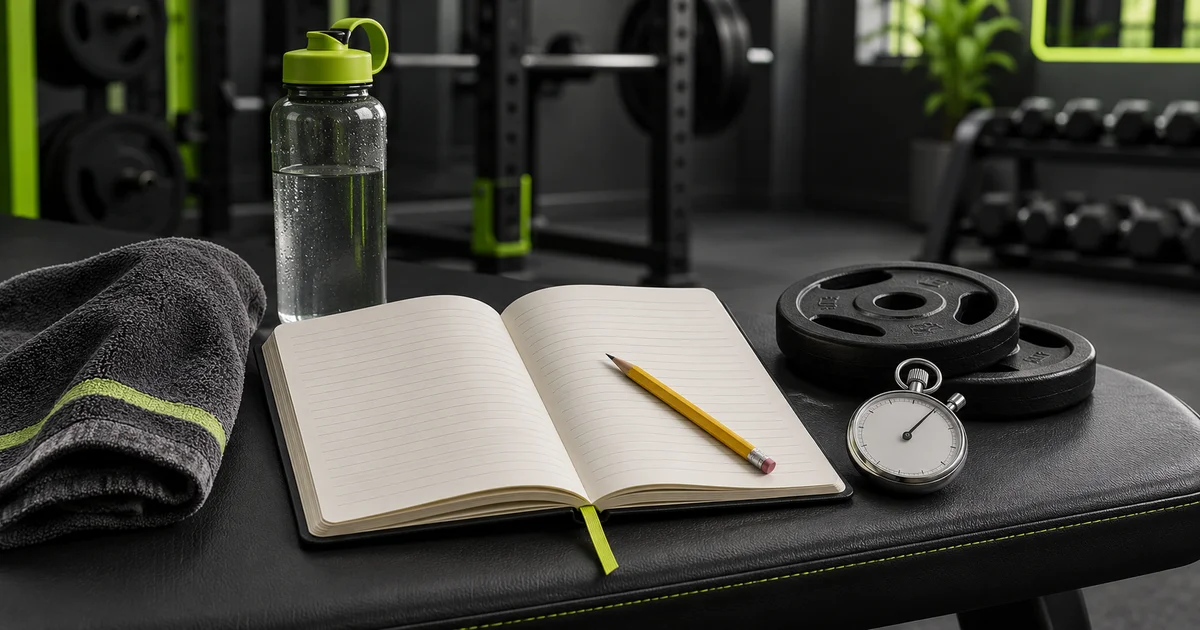
Five metrics that answer different training questions
Start here: the minimum useful log
Load, repetitions and working sets
Record what you actually did, set by set. Include the exercise variation and units so a later comparison means something. A machine stack, a pair of dumbbells and a barbell are not interchangeable measurements, even if the number displayed is the same.
- When to use this
- Use these fields every session. They show whether you completed the planned work and supply the inputs for most progression rules.
- Your next step
- Enter a set after finishing it, rather than reconstructing the whole workout from memory. Distinguish warm-ups from working sets and note whether dumbbell weight is per hand.
- Put it into practice
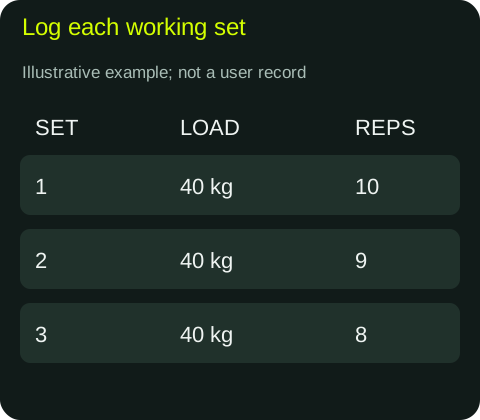
- In the example log, 40 kg for 10, 9 and 8 repetitions is three records, not “40 × 10 for three sets.” The difference matters when choosing the next load.
- Common mistake
- Rounding up failed or assisted repetitions, or changing units without recording the change.
- What to log next
- Keep exercise names consistent. Log assistance, straps or a changed machine setup when they materially affect the comparison.
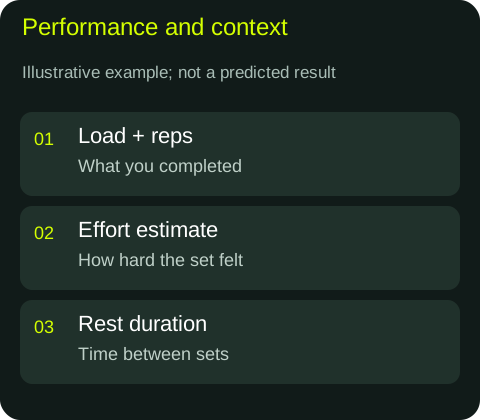
Context: how demanding was the work?
Effort and rest time
The same load and reps can represent a comfortable day or a near-limit set. An effort estimate and a rest-time record help explain the difference. For resistance training, a repetitions-in-reserve RPE scale refers to estimated remaining reps, not how sweaty the session felt.
- When to use this
- Add this context when you use effort targets, compare difficult sessions or notice a large drop between sets.
- Your next step
- Record the estimate immediately after the set. Use a consistent definition and note unusually short or long rests. If RPE is unfamiliar, begin with a plain note such as “several reps left” while learning the scale.
- Put it into practice
- Compare two sessions with similar exercise, load and reps. Before interpreting a harder final set as lost strength, check whether the rest interval was shorter.
- Common mistake
- Treating an effort estimate as exact, or confusing an easy set with technically good execution.
- What to log next
- Look for a repeated pattern across comparable sessions. A single subjective estimate is context, not a diagnosis of recovery.
Use for: workload changes
Weekly working sets and volume-load
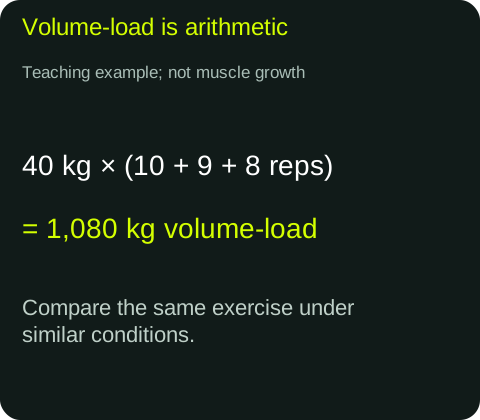
Working-set counts summarize how much training you planned and completed. Volume-load adds another view: sum load multiplied by reps across sets. It is a bookkeeping measure, not a direct measurement of muscle growth or training quality.
- When to use this
- Use it when sessions or exercise choices change and you want to see whether your total workload has risen or fallen.
- Your next step
- Count the relevant working sets consistently. Use volume-load mainly to compare the same exercise with a similar range of motion, equipment and technique.
- Put it into practice
- The example 40 × 10, 40 × 9 and 40 × 8 totals 1,080 kg of volume-load. That arithmetic describes the recorded work; it does not make this session better than every lower-tonnage session.
- Common mistake
- Adding low-value work to make a total bigger, or comparing leg-press tonnage directly with squat tonnage.
- What to log next
- Review the workload beside performance and how well you are tolerating the plan. More recorded work is useful only when it serves the training goal.
Use for: the next practice cue
Technique notes and form scores
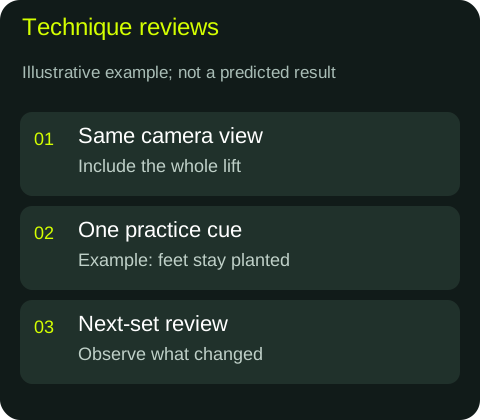
A video and one short note can explain more than a score alone. Record the exercise, load, filming angle and the point you are trying to improve. Use feedback to choose a specific practice target, then see whether you can reproduce the change.
- When to use this
- Use it when learning a movement, reviewing a recurring problem or checking whether later repetitions look different from early ones.
- Your next step
- Keep the setup and camera view comparable. Save one cue such as “feet stay planted” and record whether it helped. Treat a score as a model’s assessment of submitted footage, not an injury-risk rating.
- Put it into practice
- For a bench session, compare foot movement during the first and last rep. Follow the detailed foot-placement guide before turning a low number into an arbitrary load change.
- Common mistake
- Mixing different exercises or grading versions into one score trend, or assuming that a higher score proves a correction caused the improvement.
- What to log next
- Record visible changes as well as the number. Keep technique progress distinct from strength PRs and stop or modify painful movements.
Use for: progress you can explain
Personal records and session consistency
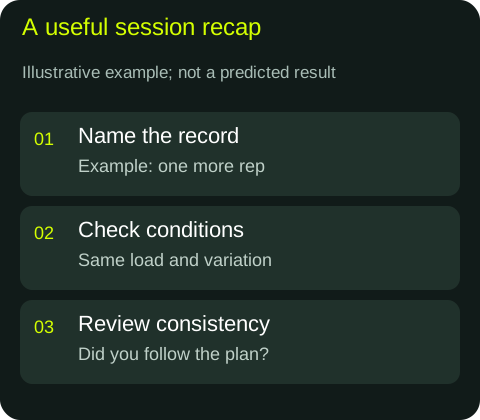
A PR is useful when its conditions are clear: a heavier load for the same repetitions, more repetitions at the same load, or another explicitly defined record. Completed sessions show whether you are following the plan often enough to evaluate it. Both belong in a recap.
- When to use this
- Use these measures at the end of a session and when reviewing a training block, rather than turning every workout into a record attempt.
- Your next step
- Name the record precisely. Include the exercise variation, load and repetitions, and distinguish an estimated maximum from a tested lift.
- Put it into practice
- A recap can say “one more rep at the same load” and “all planned sessions completed.” Neither requires a maximal single or a claim that every metric improved.
- Common mistake
- Comparing an assisted or shortened rep with an earlier strict rep, or treating a missed week as a reason to cram all the work into one session.
- What to log next
- Review records alongside technique and consistency. Share only the details you are comfortable making public; a useful recap does not need your entire training history.
Build a useful log in four steps
- Set up the session
Choose the correct exercise variation, units and planned working sets. Keep any warm-up entries distinguishable.
- Record each completed set
Save actual load and repetitions, then add effort and rest context when useful. Do not replace missed repetitions with the original target.
- Add one technique observation
For a movement you are practicing, save a representative video or a short cue. Use a consistent setup for later comparison.
- Write the next-session decision
Follow your progression rule to repeat, adjust or advance. End with a brief recap of completed work and any clearly defined record.
Review the pattern, not just the biggest number
At the end of a training block, compare sessions with the same exercise and execution standard. Check which targets became more repeatable, which required more effort, and whether the plan fit your available days. Keep the review small enough that you will actually do it.
Choose one next action from that review. A missed repetition target might mean repeating the load; an awkward equipment change might mean choosing a different plan variant. Logging cannot make that decision for you without context, but it can prevent guesses based only on the most recent workout.
Gymscore combines plans, a set logger, rest timers, video form feedback, progress views and PR sharing. Use the fields that help your next session; logging more information is not automatically more useful.
Questions answered
What is the minimum I should track?
Record the exercise variation, load and repetitions for each working set, with consistent units. Add a short note when setup or conditions change. These details are enough to begin following a simple progression rule.
Should warm-up sets count as working sets?
Keep them identifiable rather than silently combining them. You may want a complete session history, but your planned working-set total should describe the work the program intended as training sets.
Is volume-load the best measure of progress?
It is one workload measure, not a universal score. It is most interpretable for the same exercise under comparable conditions. More tonnage can come from changing the movement or adding work that does not serve your goal.
Should I track RPE and a form score?
They answer different questions. RPE estimates effort; a form score describes the model’s assessment of the video. Neither replaces actual load and reps, and an easy set is not automatically a technically consistent set.
Do I need to hit a PR every week?
No. Planned lighter work, technique practice and repeatable sessions can be useful without a new record. Judge the pattern over a training block and use like-for-like comparisons.
Sources and context
- Gymscore workout tracking, progress and PR features
- Eric Helms on effort estimates and autoregulation
- Gymscore study of 10,000 form analyses, published August 22, 2026
Published by the team behind Gymscore. Our editorial methodology explains how we use sources and update our guides.