Why Do I Lean Forward When I Squat? (And Why Posture, Not Depth, Is Usually the Problem)
Read this article in Deutsch, Español, Français, Italiano, Nederlands, Polski, Português, Svenska.
Some forward lean is normal. Too much is the top squat problem: posture was the weakest part of 50.3% of squats we scored. Causes, fixes and drills.
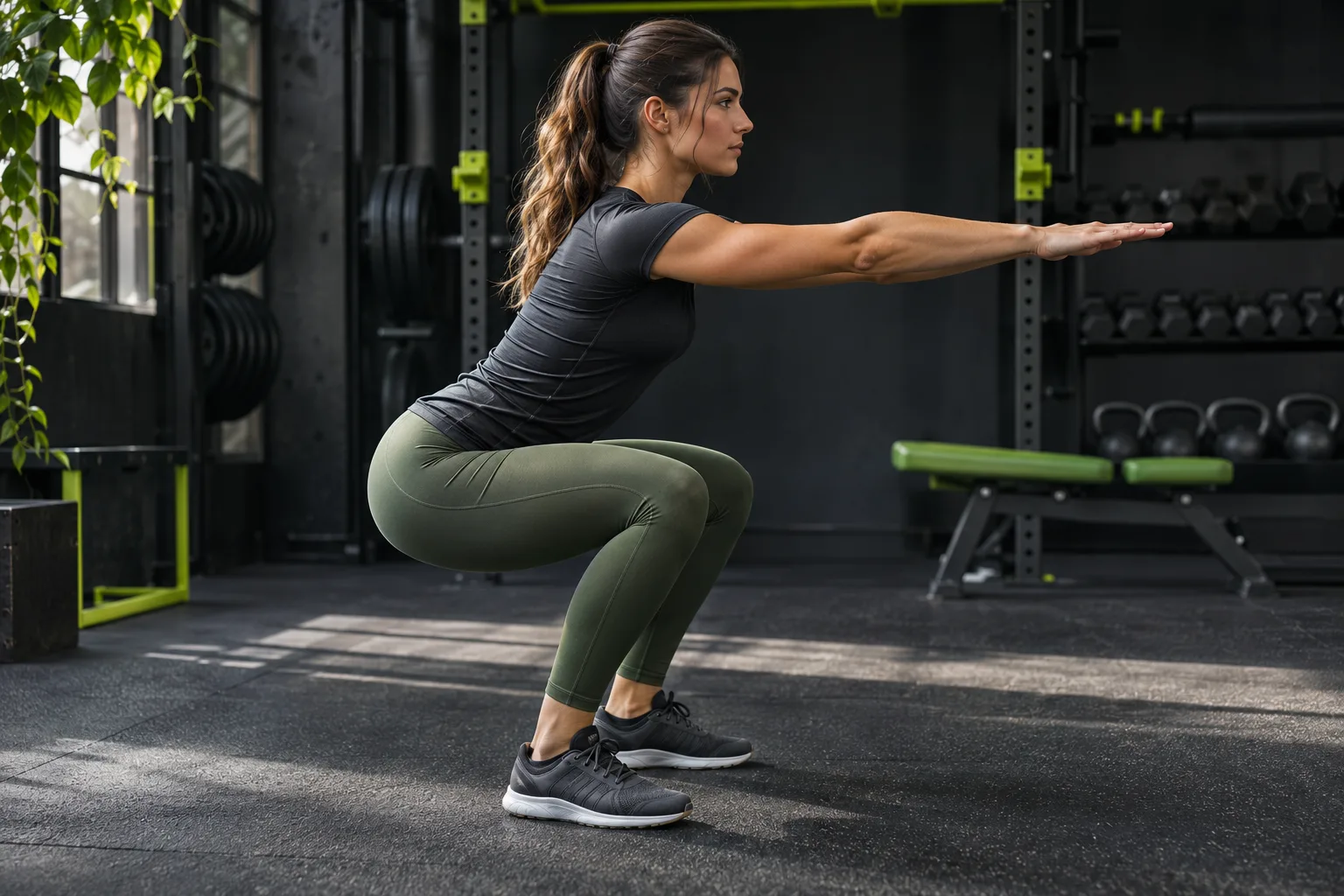
Published by the team that makes Gymscore. These observational app scores describe submitted videos, not injury risk or clinical outcomes. Repeat sets are not independent participants; exercise groups differ, and score changes do not prove cause or guarantee progress. See the original analysis and our editorial methodology. Cover image is AI-generated for illustration.
TL;DR
- Some forward lean is normal. Your torso has to tilt so the bar stays over the middle of your foot. Low-bar squats lean more than high-bar squats, and front squats lean least.
- Leaning forward becomes a problem when the bar drifts toward your toes, your hips rise faster than your chest, or your back rounds.
- Common causes: limited ankle mobility, losing your brace, tired quads, a bar position that doesn't match your goal, and too much weight.
- In Gymscore's analysis of nearly 10,000 filmed lifts, posture was the weakest part of 50.3% of 2,041 squats. Range of motion, the part most people worry about, limited only 12.2%.
- Depth came up in 66% of squat analyses but cost just 2.5 points when it was an issue. Knees caving was rarer (6.3%) but cost 18.8 points.
What the data says: posture beats depth
The analysis compared technique categories including postural alignment, foot placement, range of motion and overall movement quality. The lowest-scoring category within each analysis was called the "limiting factor."
Across 2,041 squat analyses (average score 64.6 out of 100):
| Limiting factor | Share of squats | Average sub-score |
|---|---|---|
| Postural alignment | 50.3% | 58.3 |
| Overall movement quality | 19.3% | 58.9 |
| Foot placement | 18.1% | 72.4 |
| Range of motion | 12.2% | 68.8 |
Half of all squats were held back by posture, and 44% of those posture-limited squats scored below 60.
Depth is what most people check. It was mentioned in 66% of squat analyses. But when depth was an issue, the score was only 2.5 points lower. The faults that cost more were rarer:
| Fault | Seen in | Score difference |
|---|---|---|
| Knees caving in (knee valgus) | 6.3% of squats | 18.8 points lower |
| Heels rising | 2.2% of squats | 10.0 points lower |
| Depth issue | mentioned in 66% | 2.5 points lower |
So if you film your squat and only ask "did I hit depth?", you're probably grading the wrong thing. Look at your torso first.
Is leaning forward when squatting bad?
Not by itself. When you squat, your hips move back and your knees move forward. To stay balanced, your torso tilts until the bar sits over your midfoot. As Greg Nuckols writes at Stronger by Science, squatting with a lot of forward lean "isn't inherently a problem."
How much you lean depends on:
- Bar position. Low-bar squats need more lean. High-bar squats are more upright. Front and goblet squats are the most upright.
- Your build. Longer thighs relative to your torso usually mean more lean.
- Ankle mobility. The same Stronger by Science piece covers a study that found ankle mobility explained more of the variation in forward lean than limb proportions did.
When forward lean is a problem
- The bar drifts in front of your midfoot and you shift onto your toes.
- Your hips rise faster than your chest coming out of the bottom, the "good morning squat."
- Your lower or upper back rounds under the bar.
- Your lean changes rep to rep or gets worse as the set goes on.
Torso angle naturally changes through a squat. Look for an unexpected collapse, loss of balance or loss of control rather than trying to hold one angle throughout the rep.
Why you lean forward too much when you squat
1. Limited ankle mobility
If your knees can't travel forward, your hips go further back and your chest has to come forward to balance. Heels rising (2.2% of squats in our data) is another sign your ankles are running out of range.
2. Losing your brace
If you don't breathe and brace before each rep, your upper back softens under the bar and your chest folds forward at the bottom.
3. Weak or tired quads
When your quads fade, your hips shoot up out of the bottom so your back and hips can finish the lift. It often shows up on the last reps of a set. The same pattern appears in the deadlift; see hips shooting up in the deadlift.
4. "Sitting back" too much
Cueing yourself to sit back like you're reaching for a chair pushes your hips far behind you. Your torso has to lean further to keep the bar balanced.
5. Too much weight
If your warm-ups look upright and your top sets fold, the load is outrunning your position.
How to stop leaning forward when you squat
Set your upper back
Grip the bar as narrow as your shoulders comfortably allow, pull it into your back, and squeeze your shoulder blades together. A tight upper back gives the bar a stable shelf.
Breathe and brace every rep
Big breath into your belly, brace like you're about to be poked in the stomach, then descend. Re-brace at the top of each rep.
Let your knees travel forward
Knees going past your toes is normal for most people. Letting them travel keeps your hips under you.
Raise your heels if your ankles are tight
Weightlifting shoes or a stable, purpose-built squat wedge make it easier for your knees to come forward. Nuckols suggests raised-heel shoes or a slightly wider stance with more focus on knees out.
Cue "chest and hips up together"
Out of the bottom, think about driving your upper back into the bar so your chest and hips rise at the same rate.
Match the squat to your goal
If you want to be more upright, a high-bar, front or goblet squat will get you there. In our data, front squats averaged 79.8 and goblet squats 75.5, against 67.9 for barbell back squats. Different groups performed these variations, so the score gap does not prove that switching exercises improves technique; see the full comparison in trap bar vs conventional deadlift.
Knees caving in when squatting
Knees caving in (knee valgus) appeared in only 6.3% of squats, but those lifts scored 18.8 points lower, the biggest single-fault gap for the squat. A few things that commonly help:
- Spread the floor. Keep your whole foot planted, big toe, little toe and heel, and push your knees in line with your toes.
- Adjust your stance. Try a slightly different width or toe angle so your knees can track over your feet.
- Slow the descent. A 2 to 3 second lowering makes it easier to see and control where the knees cave.
- Drop the weight if it only happens on heavy sets.
If your knees hurt when you squat, see a qualified professional such as a physiotherapist.
Squat posture checklist
- Bar position chosen on purpose: high bar, low bar or front.
- Upper back tight, bar set firmly.
- Feet about shoulder width, toes slightly out, whole foot planted.
- Big breath, brace.
- Knees and hips bend together; knees track over toes.
- Bar stays over midfoot all the way down and up.
- Chest and hips rise together out of the bottom.
- Re-brace before the next rep.
Common mistakes
- Trying to stay perfectly upright in a low-bar squat. Some lean is the point.
- Only checking depth on video.
- Sitting back too far.
- Losing your brace between reps.
- Looking up hard to force your chest up.
- Adding weight while your torso angle is still changing rep to rep.
Drills to fix forward lean
1. Paused squats
Pause 2 to 3 seconds at the bottom, stay tight, then stand. If you fold forward in the pause, the weight is too heavy or your brace is too loose.
2. Goblet squats
Holding a weight in front pulls your torso upright. Use them as a warm-up to feel the position before you squat with a bar.
3. Tempo squats
Lower over 3 seconds. Slowing down lets you feel where your torso starts to tip.
4. Heels-elevated squats
A stable heel wedge or weightlifting shoes can change squat mechanics. A more upright position may suggest ankle range plays a role, but this is not a diagnostic test.
How to film your squat to check your posture
- Side-on at hip height, whole body and bar in frame. This shows torso angle, bar position over the foot and depth.
- Front view for knee tracking.
- Pause at the bottom of the rep: is the bar over your midfoot?
- Compare your first and last rep. Does your torso angle change?
If you want to check depth separately, see how to check your squat depth without a coach. For the basics, see our squat form guide.
To get a score instead of eyeballing it, film your squat in Gymscore. You get a 0-100 form score with sub-scores for postural alignment, bracing, foot placement, range of motion and overall movement quality, plus tips on what to fix. The squat form checker page shows what to keep in frame. The full dataset is in our analysis of nearly 10,000 filmed lifts.
Squat scores tend to move slowly once you're past the basics; see how long it takes to fix your form. Film one set side-on next session, check your torso before your depth, and score it in Gymscore.
FAQ
Why do I lean forward when I squat?
Your torso has to lean so the bar stays over your midfoot as your hips move back. You lean too much when your ankles limit how far your knees can travel, when you lose your brace, when your quads tire, or when the weight is too heavy for your position.
Is leaning forward when squatting bad?
Not on its own. Low-bar squats need more forward lean than high-bar or front squats. It becomes a problem when the bar drifts toward your toes, your hips rise faster than your chest, or your back rounds.
How do I stop leaning forward when I squat?
Tighten your upper back, brace before every rep, let your knees travel forward, and drive your chest and hips up together. If your ankles are tight, try raising your heels. Paused and goblet squats help you practise the position.
Is squat depth or posture more important?
In Gymscore's analysis of 2,041 squats, posture was the weakest part of 50.3% of lifts and range of motion only 12.2%. Depth was mentioned in 66% of analyses but cost only 2.5 points when it was an issue. Check both, but check your torso first.
Why do my knees cave in when I squat?
Common reasons are losing pressure through the whole foot, a stance that doesn't let your knees track over your toes, and weights that are too heavy. Knees caving appeared in 6.3% of squats in Gymscore's data, with scores 18.8 points lower. If it hurts, see a qualified professional.
What is the most common squat form mistake?
Posture. In Gymscore's analysis of nearly 10,000 filmed lifts, postural alignment was the limiting factor in 50.3% of squats, ahead of overall movement quality (19.3%), foot placement (18.1%) and range of motion (12.2%).