The Gymscore training library · Plans
Beginner Program Paths: Choose Your First 8–12 Weeks
Choose one main goal, build a repeatable week and use your workout log to decide what to change next.
Beginner goal paths: an illustrative first-block framework
Compare the options below. Scroll the table sideways on smaller screens.
| Main goal | Starting structure | Progress signal | Avoid chasing |
|---|---|---|---|
| Strength | Practice a few repeatable main lifts | More controlled reps or load at comparable effort | Frequent maximum attempts |
| Muscle growth | Repeatable work across major muscle groups | More reps or load without losing control | Soreness as the main target |
| Fat-loss support | Consistent lifting alongside broader habits | Attendance and maintained training performance | A workout calorie-burn contest |
| General fitness | Manageable lifting plus enjoyable movement | A routine that remains repeatable | The most complicated split |
The 8–12-week timelines below are illustrative planning blocks, not measured Gymscore outcomes or promises of physical change. Adapt their pace to your starting point and the program you choose. Sources and context ↓
Quick picks
- Want to lift more with control → prioritize the strength path and log comparable sets.
- Want to build muscle → choose repeatable exercises and a progression rule you can sustain.
- Want training to support fat loss → protect a consistent lifting routine instead of adding endless fatigue.
- Unsure of your goal → start with general fitness, then review what you enjoy and can repeat.

Four beginner paths and how to use them
Best for: building repeatable lifting skill
Strength: practice the lifts you want to improve
The strength path gives a few main movements consistent attention. A beginner does not need to test a maximum to begin: manageable sets can establish technique, starting loads and a useful baseline. Choose variations that fit your equipment and skill.
- When to use this
- Use it when your main objective is to move more load with repeatable technique, rather than collect many different exercises.
- Your next step
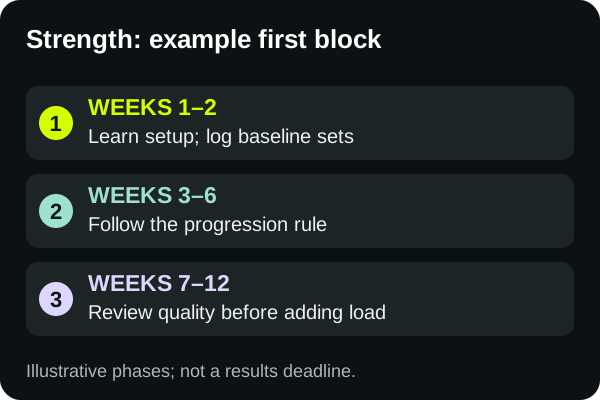
- In weeks 1–2, learn setup and log comfortable working sets. During weeks 3–6, follow the chosen program’s rep or load progression. Through weeks 7–12, keep progressing only when its criteria are met.
- Put it into practice
- Film one selected working set from a consistent angle. Compare the first and last reps before deciding that a heavier set represents the same quality of work.
- Common mistake
- Do not turn each session into a max test or raise the load just because a calendar week changed.
- What to log next
- Keep load, reps, effort and setup notes. A controlled extra rep can be useful progress even when the weight stays the same.
Best for: a consistent muscle-building routine
Muscle growth: make the work repeatable
This path organizes repeatable work across the muscle groups you want to train. Free weights, machines and suitable bodyweight variations can all be part of the plan. Exercise variety should help you train, not make each session impossible to compare with the last.
- When to use this
- Use it when muscle growth is your main goal and you can consistently repeat the chosen movements and sessions.
- Your next step
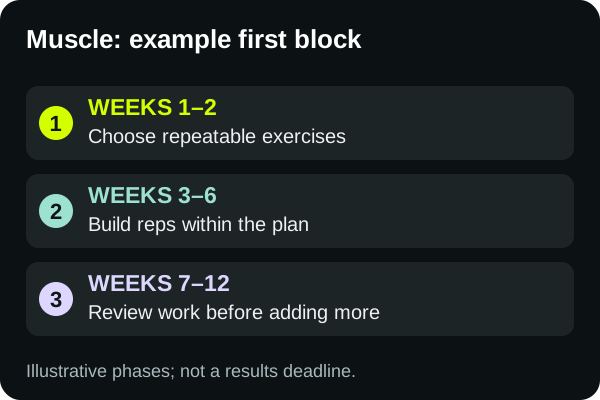
- Use weeks 1–2 to find manageable exercises and working loads. In weeks 3–6, progress within the plan’s rep ranges. In weeks 7–12, review performance before adding more work.
- Put it into practice
- Keep a small set of anchor exercises stable. For a rep-range exercise, practice completing the planned reps with consistent range and control before increasing weight.
- Common mistake
- Do not add sets simply to feel sore. Extra work that makes later sessions rushed or repeatedly incomplete is not automatically useful.
- What to log next
- Log working sets, reps, load and effort. Review more than one session before deciding that an exercise or progression method needs changing.
Best for: maintaining a training routine during a broader goal
Fat-loss support: keep training sustainable
A lifting plan can support a fat-loss effort, but it is not a complete nutrition or weight-management plan. This path focuses on consistent resistance training and useful performance records. It does not promise a rate of weight loss or require a special fat-burning split.
- When to use this
- Use it when fat loss is the broader goal and you want a gym routine you can sustain rather than a session designed only to feel exhausting.
- Your next step
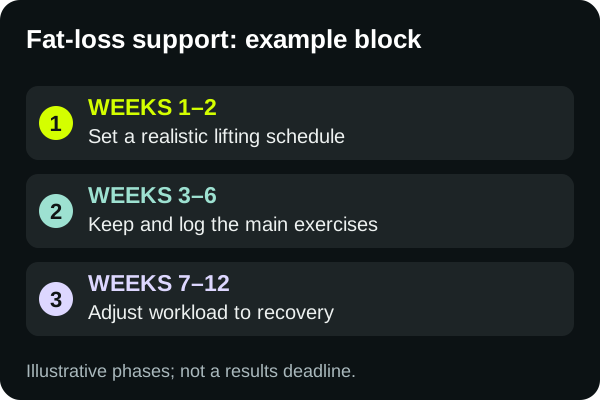
- Spend weeks 1–2 choosing a realistic schedule. In weeks 3–6, keep the main exercises and record performance. During weeks 7–12, adjust workload if the current routine is becoming difficult to recover from.
- Put it into practice
- Pair a manageable lifting routine with everyday movement you enjoy. Keep demanding sessions separate from any urge to compensate for food with exercise.
- Common mistake
- Do not judge the plan by sweat, soreness or an exercise calorie estimate. Those are not interchangeable with long-term body-composition change.
- What to log next
- Track attendance and whether comparable sets remain manageable. If fatigue persists, review sleep, overall workload and broader habits rather than automatically adding more training.
Best for: establishing a practical training habit
General fitness: build a week you can keep
General fitness is a valid primary goal. A short, clear routine can help you practice lifting while leaving time for walking, cycling, sport or other activities you enjoy. You do not need to choose a bodybuilding or powerlifting identity before starting.
- When to use this
- Use it when you are new, returning after time away or still learning which activities fit your life.
- Your next step
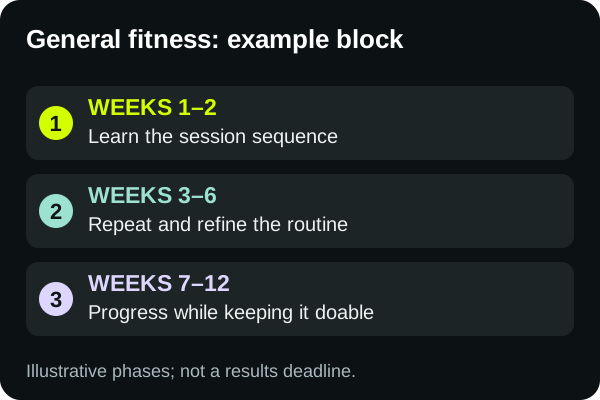
- In weeks 1–2, establish your gym route and session order. During weeks 3–6, repeat the routine and refine setup. Through weeks 7–12, make small progressions while keeping the week manageable.
- Put it into practice
- Choose a handful of accessible movements and repeat them. Keep at least one simple note about what made a session easier to start or finish.
- Common mistake
- Do not compare your starting routine with someone else’s advanced split. The most elaborate plan is not automatically the most useful one.
- What to log next
- Log attendance, completed work and effort. At the end of the block, choose whether to keep the routine or focus more specifically on strength or muscle.
Turn a goal into your first training block
- Choose one main outcome
Write down whether strength, muscle, fat-loss support or general fitness is your current priority. Other benefits can still matter; the main goal helps resolve scheduling and exercise choices.
- Choose the schedule you can repeat
Start with available days and session length, then choose a complete program. Check that its equipment and progression rules are understandable before the first workout.
- Establish a baseline without max testing
Use manageable loads, learn the setup and record completed sets. Keep a few repetitions available when appropriate to the plan rather than improvising repeated all-out attempts.
- Review the log at checkpoints
After the opening sessions and again later in the block, review attendance, repeatable technique and workload. Extend a learning phase or simplify the plan when needed; the example week numbers are not deadlines.
What to review after the first block
The aim of an 8–12-week framework is to give your routine a review point, not to promise a transformation. Look for a pattern across sessions: can you attend, repeat the movements and understand the next progression decision? A difficult week does not erase the work already completed.
ACSM’s 2026 guidance emphasizes consistency and training the major muscle groups at least twice weekly. Use that broad guidance when evaluating the whole routine, rather than assuming a particular split name is required. Your chosen program still determines the exercises and workload.
If a movement causes pain, stop or adjust it rather than forcing a progression target. Persistent or worsening symptoms need qualified individual assessment. An app score or a sample program cannot diagnose the cause.
Gymscore’s questionnaire can turn your goals, schedule and equipment into a starting plan. Review the result before training, then keep session records so later changes respond to what actually happened. Photo import in the app is for an existing written routine; it is a separate feature from the web questionnaire.
Questions answered
Is eight weeks enough to know whether a beginner plan works?
It can be a useful review point for attendance, exercise familiarity and comparable training performance. It is not a guaranteed deadline for strength, muscle or body-composition changes. Review the quality and consistency of the work before judging a plan by appearance alone.
Can a beginner build strength and muscle together?
The goals can overlap. Choosing a main goal helps organize the plan; it does not mean every other adaptation stops. Use a complete routine with suitable exercises, manageable effort and a clear progression method.
Do I need a different split for fat loss?
There is no single mandatory fat-loss split. Choose a lifting schedule you can sustain alongside the broader habits relevant to your goal. Do not assume that more exhausting workouts guarantee greater fat loss.
What if I miss a week?
Resume according to the program and your current readiness rather than cramming all the missed work into the next session. Use manageable loads, check technique and record the interruption so comparisons have context.
Can I start without knowing my one-rep maximum?
Yes. Many beginner routines can establish working loads from manageable practice sets and effort. If a specific program uses a training max, follow that program’s instructions and use an appropriate conservative estimate rather than forcing a maximum test.
Sources and context
- ACSM: 2026 resistance training guidance
- Gymscore questionnaire and plan generator
- Gymscore V2 planning, import and workout logging
Published by the team behind Gymscore. Our editorial methodology explains how we use sources and update our guides.