Hips Shooting Up in the Deadlift? Why It Happens and How to Fix It
Read this article in Deutsch, Español, Français, Italiano, Nederlands, Polski, Português, Svenska.
Hips shooting up showed up in 20.4% of deadlifts Gymscore scored. Why your hips rise first, how to set your start position, and drills to fix it.
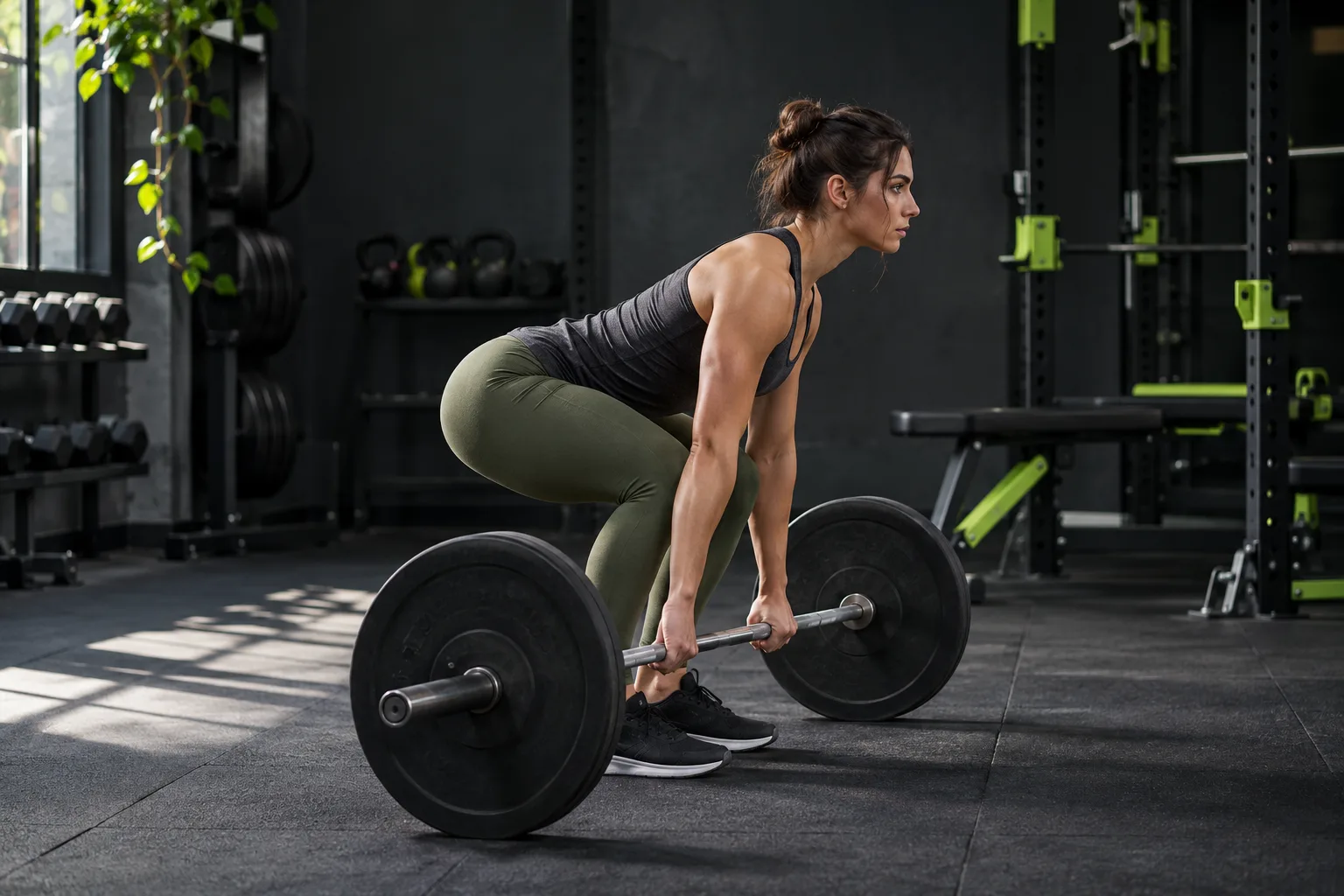
Published by the team that makes Gymscore. These observational app scores describe submitted videos, not injury risk or clinical outcomes. Repeat sets are not independent participants; exercise groups differ, and score changes do not prove cause or guarantee progress. See the original analysis and our editorial methodology. Cover image is AI-generated for illustration.
TL;DR
- Hips shooting up means your hips rise before the bar leaves the floor, or faster than your shoulders, turning the pull into a stiff-legged deadlift.
- One common reason is starting with your hips too low. Another is not taking the slack out of the bar, so your legs extend before the bar moves.
- In Gymscore's analysis of nearly 10,000 filmed lifts, hips shooting up showed up in 20.4% of 1,339 deadlifts, and those lifts scored 11.4 points lower on average.
- The fix: set your hips where they would rise to anyway, pull the slack out, push the floor away, and keep your chest and hips rising together.
- Your feet are almost never the problem. Foot placement was the weakest part of only 4.7% of deadlifts.
What the data says about hips shooting up
The analysis compared technique categories including postural alignment, foot placement, range of motion and overall movement quality. The lowest-scoring category within each analysis was called the "limiting factor."
Across 1,339 deadlift analyses (average score 57.5 out of 100):
| Limiting factor | Share of deadlifts | Average sub-score |
|---|---|---|
| Postural alignment | 67.1% | 42.1 |
| Overall movement quality | 20.3% | 47.5 |
| Range of motion | 7.9% | 58.1 |
| Foot placement | 4.7% | 82.4 |
Posture was the weakest link in two out of three deadlifts, and its average of 42.1 was the lowest sub-score for any lift in the dataset. 64% of deadlift posture scores were below 60.
Two faults drive most of that:
| Fault | Seen in | Score difference |
|---|---|---|
| Hips shooting up | 20.4% of deadlifts | 11.4 points lower |
| Lower back rounding | 15.1% of deadlifts | 17.0 points lower |
Hips shooting up was the more common of the two, and they're linked: when your hips rise first, your torso tips over the bar, which is where the lower back tends to round. Foot placement, meanwhile, averaged 82.4. The lift goes wrong above the ankles.
Why do your hips shoot up when you deadlift?
1. You start with your hips too low
This is the big one. A lot of lifters set up for a deadlift like a squat: hips low, chest very upright, shins angled forward. It feels strong, but it usually pushes your knees and the bar forward of your midfoot.
When the bar gets heavy, your body finds the more efficient position on its own. The hips rise to where they "wanted" to start, then the bar moves. On video, that's hips shooting up. Coach Mia Inman makes the same point on Starting Strength: hips may lead at the start of the pull if they were too low to begin with.
2. You don't take the slack out of the bar
If you yank the bar, your legs straighten first and the bar only moves once everything else catches up. The hips rise, then the bar breaks. Pulling the slack out means getting tension through your arms, lats and torso before the plates move.
3. You think "pull with your back" instead of "push with your legs"
The first part of a conventional deadlift is mostly the knees extending: you're pushing the floor away. If you think of it as pulling the bar up with your back, your knees lock out early and your hips do the lifting.
4. Your legs fade, or the weight is too heavy
If your hips stay put on warm-ups and shoot up only on top sets or late reps, your quads can't hold the knee angle at that load. That's a programming fix as much as a form fix.
How to fix hips shooting up in the deadlift
Set the right start position
Use this as a checklist from the side:
- Bar over midfoot. Roughly over the middle of your foot, not over your toes.
- Shins touching the bar without rolling it forward.
- Shoulders slightly ahead of the bar. If your shoulders are behind the bar, your hips are probably too low.
- Hips between your knees and shoulders. Higher than a squat, lower than a stiff-legged deadlift. Your exact height depends on your proportions.
- Arms straight, hanging vertically.
If you're not sure where your hips belong, try this: set up, pull the slack out, and slowly lift a light bar. Wherever your hips sit when the bar actually breaks from the floor is close to where they should start.
Pull the slack out
Before the bar moves, squeeze it into your shins, pull your shoulders down into your back pockets, and pull up just hard enough to hear the bar click against the plates. Your hips will settle into place as you do this. Then brace and push.
Push the floor away
Cue the first part of the lift as a leg press: drive your whole foot into the floor and let the bar ride up your shins. Inman's cue is "freeze your knees, push the floor," which keeps the knees from snapping straight while the legs still do the work.
Keep chest and hips rising together
From the floor to just below the knee, your back angle should barely change. If your hips rise and your chest stays down, that's the fault. "Chest and hips together" or "lift your chest as you push" helps a lot of people.
Deadlift setup checklist
- Bar over midfoot, feet about hip width.
- Hinge down and grip just outside your legs.
- Shins to the bar without moving it.
- Chest up, shoulders slightly ahead of the bar, arms straight.
- Pull the slack out until the bar clicks.
- Breathe and brace.
- Push the floor away. Chest and hips rise together, bar against your legs.
- If your hips shot up, reset before the next rep instead of grinding.
Common mistakes
- Squatting the deadlift: hips too low, bar drifting forward.
- Jerking the bar off the floor instead of pulling the slack out first.
- Letting the bar drift away from your legs once it leaves the floor.
- Chasing a number with reps where the hips shoot up and the back rounds.
- Blaming your feet. In our data, foot placement is rarely the limiter on the deadlift.
For the other big deadlift faults, including bar drift and lockout, see our 5 deadlift form mistakes.
Drills to stop your hips rising first
1. Paused deadlifts
Pull to just below the knee, hold for 2 to 3 seconds, then finish the rep. If your hips shot up, you'll feel it in the pause: you'll be tipped over the bar with your weight on your toes. Use a weight well below your working sets.
2. Slack-pull reps
Set up, pull the slack out, hold the tension for 3 seconds without the bar leaving the floor, then lift. This teaches you that the bar moves only after you're tight.
3. Tempo pulls off the floor
Take 3 seconds to move the bar from the floor to the knee. Slowing it down makes it very obvious whether your hips are leading.
4. Trap bar deadlifts
A trap bar puts the load at your sides, which lets most people stay more upright. In our data, trap bar deadlifts averaged 69.2 against 56.3 for conventional deadlifts, and improved faster with repeat filming. See trap bar vs conventional deadlift for the full comparison.
Hips shooting up in the squat too?
The squat version, the "good morning squat," has overlapping causes: lost tension, tired quads, too much load. See why you lean forward when you squat.
How to film your deadlift to check your hips
You can't feel your hip position reliably while you pull. A phone can see it.
- Side-on at hip height, about 3 to 4 metres away. Keep your whole body and both plates in frame.
- Film from the setup, not from the first pull. Most hip problems start with where you set them.
- Watch the first inch of the pull. Pause the video when the plates leave the floor. Did your hips move before the bar did?
- Compare first and last reps. Late-set hip rise means fatigue or load.
For a score instead of a guess, film your deadlift in Gymscore. You get a 0-100 form score with sub-scores for postural alignment, bracing, foot placement, range of motion and overall movement quality, plus specific tips on what to fix. The deadlift form checker page shows what to keep in frame.
Fixing this takes some reps. Deadlift scores rose about 1.55 points per repeat attempt in our data, so expect gradual progress. See how long it takes to fix your form. For the full dataset, read our analysis of nearly 10,000 filmed lifts.
Next session, set up with your shoulders ahead of the bar, pull the slack out, film one set side-on, and score it in Gymscore. Fix one thing, then film again.
FAQ
Why do my hips shoot up when I deadlift?
One possibility is that you started with your hips too low, so they rise to a more efficient position before the bar moves. Other causes are not pulling the slack out of the bar, thinking "pull with your back" instead of "push the floor," and weights that are too heavy for your current technique.
How do I stop my hips rising first in the deadlift?
Start with the bar over midfoot and your shoulders slightly ahead of the bar, pull the slack out until the bar clicks against the plates, then push the floor away so your chest and hips rise together. Paused deadlifts just below the knee and slow tempo pulls help you feel the difference.
Is it bad if my hips rise first in the deadlift?
It usually makes the lift less efficient. Your torso tips over the bar and your back takes more of the load. In Gymscore's analysis of 1,339 deadlifts, lifts where the hips shot up scored 11.4 points lower on average. If your back hurts when you deadlift, see a qualified professional such as a doctor or physiotherapist.
How high should your hips be when you deadlift?
Higher than in a squat and lower than your shoulders. From the side, the bar should be over midfoot, your shins touching the bar and your shoulders slightly ahead of it. The exact hip height depends on your arm, leg and torso length.
What is the most common deadlift form mistake?
In Gymscore's analysis of nearly 10,000 filmed lifts, postural alignment was the weakest part of 67.1% of deadlifts. The most common specific fault was hips shooting up, seen in 20.4% of deadlifts, followed by lower back rounding at 15.1%.
Are my feet causing my hips to shoot up?
The dataset cannot diagnose an individual setup. Foot placement was the weakest part of only 4.7% of deadlifts in Gymscore's data, with an average sub-score of 82.4. A conventional stance much wider than hip width can make it harder to use your legs, but fix your hip height and slack before changing your feet.