Pull-Up and Push-Up Form Mistakes: Why the Basics Score So Low (and How to Fix Them)
Read this article in Deutsch, Español, Français, Italiano, Nederlands, Polski, Português, Svenska.
Pull-ups averaged 36.1 and push-ups 40.6 out of 100 in Gymscore's form data. The most common mistakes, how to fix them, and why pull-ups improve fast.
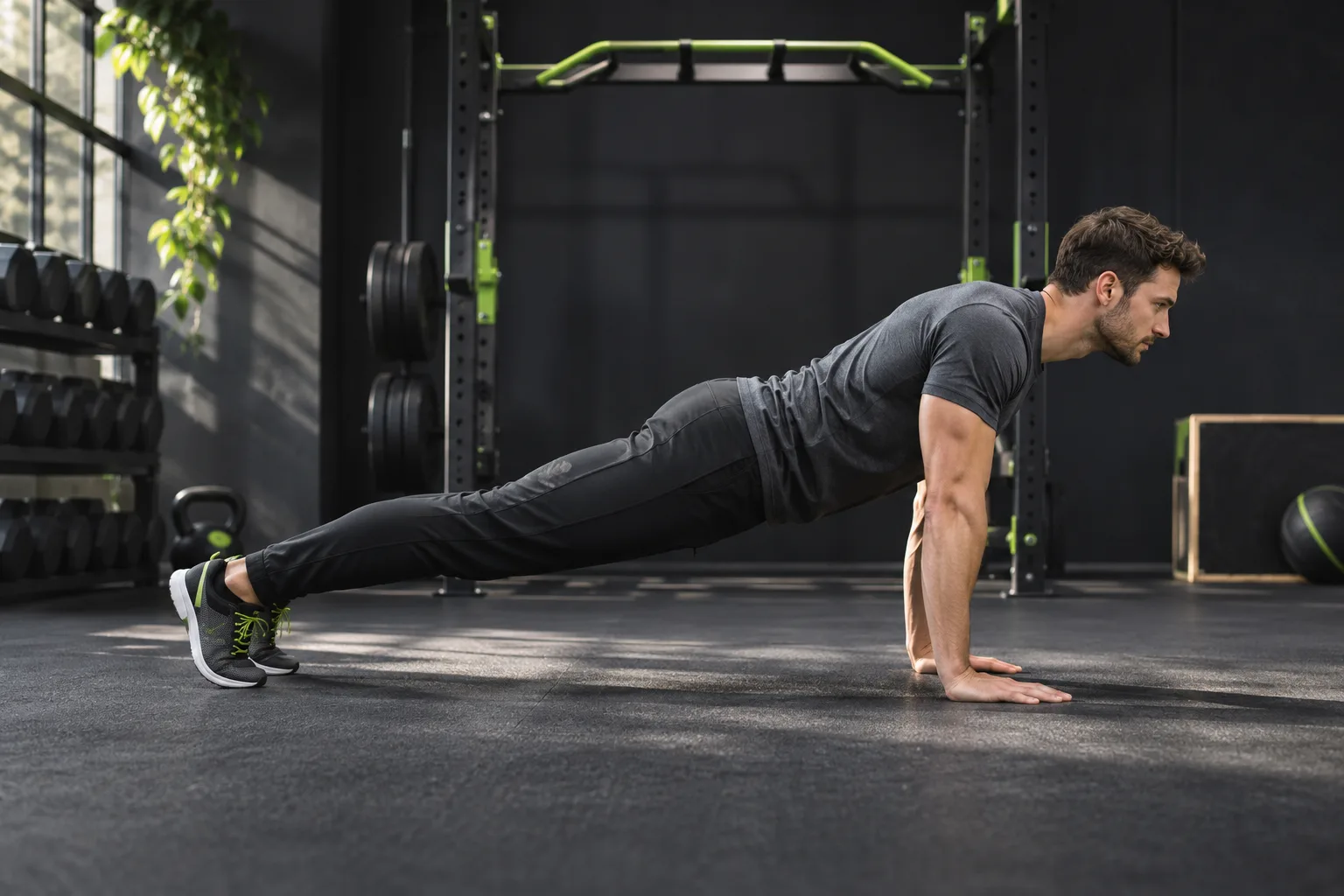
Published by the team that makes Gymscore. These observational app scores describe submitted videos, not injury risk or clinical outcomes. Repeat sets are not independent participants; exercise groups differ, and score changes do not prove cause or guarantee progress. See the original analysis and our editorial methodology. Cover image is AI-generated for illustration.
TL;DR
- The most common pull-up mistakes are half reps, swinging, shrugging, craning your neck to reach the bar, and dropping from the top. The most common push-up mistakes are sagging hips, half reps, elbows flared straight out, and a head that drops first.
- In Gymscore's analysis of nearly 10,000 filmed lifts, pull-ups averaged 36.1 out of 100 and push-ups 40.6, two of the five lowest-scoring exercises. Front squats averaged 79.8.
- The good news: pull-ups improved faster than any lift we measured, +2.84 points per repeat attempt, from a starting average of 30.9.
- The fix for both is the same idea: full range, a still body, and fewer, better reps. Use easier versions until you can do that.
What the data says
The analysis compared technique categories including postural alignment, foot placement, range of motion and overall movement quality. The current app also gives feedback on bracing.
When we ranked exercises by average score, the bottom of the list wasn't full of complicated barbell lifts. It was the basics:
| Lowest-scoring exercises | Average score | Analyses |
|---|---|---|
| Smith machine bench press | 35.9 | 17 |
| Pull-up | 36.1 | 63 |
| Chair dips | 36.9 | 24 |
| Dumbbell bicep curl | 37.7 | 39 |
| Push-up | 40.6 | 164 |
For comparison, the top of the list:
| Highest-scoring exercises | Average score | Analyses |
|---|---|---|
| Snatch | 81.6 | 20 |
| Front squat | 79.8 | 31 |
| Goblet squat | 75.5 | 74 |
| Weighted pull-ups | 74.6 | 15 |
| Hack squat | 74.0 | 23 |
The weighted pull-up result is telling. Weighted pull-ups averaged 74.6, about double the regular pull-up. The weighted group may be more experienced, but experience was not controlled here. These different cohorts cannot show that adding weight or practising alone caused the score gap.
Possible explanations for the low scores include the following; the dataset did not test these causes:
- Nobody coaches them. People film and rehearse their squat setup. Few people think about push-up technique.
- They're hard to scale. You can't take 2.5 kg off a push-up. If your bodyweight is near your limit, form breaks.
- Reps get counted, not judged. Chasing a number of pull-ups or push-ups encourages shorter, swingier reps.
Pull-up form mistakes
1. Half reps
Starting with bent elbows, or stopping before your chin clears the bar, cuts out the hardest part of the rep. Every rep should start from straight arms and finish with your chin over the bar.
2. Swinging and kipping
A little sway turns into momentum, and momentum does a growing share of the work. Unless you're deliberately training kipping pull-ups, keep your legs still: squeeze your glutes, brace your abs, and pause briefly at the bottom.
3. Shrugging
If your shoulders ride up to your ears as you pull, your arms and neck end up doing work your back should do. Before you bend your elbows, pull your shoulder blades down. "Shoulders in your back pockets" is the usual cue.
4. Craning your neck
Reaching your chin up toward the bar makes the rep look complete when your body hasn't risen enough. Keep your neck neutral and bring your chest toward the bar.
5. Dropping from the top
Letting yourself fall wastes the lowering half of the rep and makes the next rep messier. Lower yourself under control.
6. Grinding every set to failure
When the last reps crawl, they usually get shorter and swingier. Stop most sets a rep or two before your form breaks.
Why are pull-ups so hard?
Because you're lifting your whole bodyweight with your back and arms, and you can't make it lighter the way you can strip a plate off a barbell. Among users who filmed pull-ups more than once, the starting score averaged just 30.9.
They also improved fastest. Within users who filmed pull-ups more than once, scores rose by an average of 2.84 points per repeat attempt, more than trap bar deadlifts (+2.52) or bench press (+2.46). That observed trend is encouraging, but it does not establish how fast you will improve or whether filming caused the change.
Pull-up progressions that keep your form
- Dead hangs and scapular pull-ups to build grip and practise pulling your shoulders down.
- Negatives: jump or step to the top, then lower yourself over 3 to 5 seconds.
- Band-assisted pull-ups for full-range reps with less load.
- Lat pulldowns or inverted rows for extra volume at a weight you control.
Push-up form mistakes
1. Sagging hips
The most visible push-up fault. Your hips drop toward the floor and your lower back arches. Squeeze your glutes and brace your abs so your body moves in one straight line from head to heels.
2. Piking your hips up
The opposite fault: your butt goes up to make the rep easier. Same fix: one straight line.
3. Half reps
Stopping a few centimetres down cuts the hardest part of the rep. Lower until your chest is close to the floor, then press to straight arms.
4. Elbows flared straight out
Elbows at 90 degrees to your body, making a T shape, is a position many lifters find hard on the front of the shoulders. Tuck your elbows to a moderate angle, somewhere between your sides and straight out, so your body makes more of an arrow than a T. The same idea applies on the bench press; see bench press shoulder pain.
5. Leading with your head
If your nose reaches the floor before your chest, your neck is doing the work. Keep your head in line with your body and look at the floor just ahead of your hands.
6. Hands too far forward
Hands out in front of your shoulders make the bottom position awkward. Put your hands roughly under your shoulders, a bit wider than shoulder width.
Why are push-ups so hard?
For the same reason as pull-ups: you're moving a big share of your bodyweight, and you can't make it a little lighter. That's why the fix is changing the angle, not forcing ugly reps.
Push-up progressions that keep your form
- Incline push-ups on a bench, box or bar. The higher your hands, the easier it is.
- Negatives: lower over 3 seconds, then reset from your knees.
- Knee push-ups if you keep the same straight line from knees to head.
- Dumbbell pressing for extra chest work. In our data, dumbbell bench averaged 56.2 against 49.2 for barbell bench.
Form checklist
Pull-up
- Grip slightly wider than shoulder width.
- Start from a full hang, arms straight.
- Pull your shoulders down.
- Brace, legs still.
- Pull your chest toward the bar until your chin clears it.
- Lower under control to straight arms.
Push-up
- Hands roughly under your shoulders, a bit wider.
- Squeeze glutes, brace abs: one straight line.
- Elbows at a moderate angle, not straight out.
- Lower until your chest is close to the floor.
- Press to straight arms without your hips sagging or piking.
Drills
1. Paused reps
Pause for 2 seconds with your chin over the bar, or with your chest just above the floor. If you cannot hold the pause, reduce the difficulty and review control; the pause alone cannot identify the cause.
2. Slow negatives
Lower over 3 to 5 seconds. It builds strength where you're weakest and makes form problems obvious.
3. Fewer, cleaner sets
Do several sets that stop well short of failure instead of one all-out set. More good reps, fewer bad ones.
How to film your pull-ups and push-ups
- Pull-ups: side-on, far enough back to see your whole body and the bar. This shows range of motion, swing and whether your chin or chest reaches the bar. A front view shows shrugging and uneven pulling.
- Push-ups: side-on at floor level, whole body in frame. This shows hip sag, depth and head position.
- Film the whole set. Most bodyweight form breaks down in the last few reps.
To score your sets, film them in Gymscore. You get a 0-100 form score with sub-scores for postural alignment, bracing, foot placement, range of motion and overall movement quality, plus tips on what to fix. Our AI form check page covers how it works, and the full exercise rankings are in our analysis of nearly 10,000 filmed lifts.
For how quickly scores tend to move, see how long it takes to fix your form. Film one set of pull-ups or push-ups this week, fix the biggest problem, and score it again in Gymscore.
FAQ
What are the most common pull-up form mistakes?
Half reps, swinging, shrugging your shoulders toward your ears, craning your neck to reach the bar, and dropping from the top. Start every rep from straight arms, pull your shoulders down, keep your body still, and lower yourself under control.
Am I doing pull-ups wrong?
If your elbows stay bent at the bottom, your chin doesn't clear the bar, your legs swing, or your shoulders shrug as the set gets hard, your form needs work. Film one set from the side. In Gymscore's data, pull-ups averaged 36.1 out of 100, so you're not alone.
What are the most common push-up form mistakes?
Sagging hips, piking your hips up, half reps, elbows flared straight out to the sides, and leading with your head. Keep one straight line from head to heels, tuck your elbows to a moderate angle, and lower until your chest is close to the floor.
Why are pull-ups so hard?
You're lifting your whole bodyweight, and you can't make it lighter the way you can with a barbell. In Gymscore's data, pull-ups averaged 36.1 out of 100, but they improved fastest of any lift measured, at 2.84 points per repeat attempt.
Should I do knee or incline push-ups if I can't do a full push-up?
Either works if you keep a straight line from head to knees or heels. Incline push-ups are easy to scale: the higher your hands, the easier the rep. Move to a lower surface as your form holds.
Why do pull-ups and push-ups score so low?
They're rarely coached, they're hard to scale, and people tend to count reps rather than judge them. In Gymscore's analysis of nearly 10,000 filmed lifts, pull-ups averaged 36.1 and push-ups 40.6, while weighted pull-ups, usually done by more practised lifters, averaged 74.6.